

Shrinking labor force and “good enough” hiring contributing to stable jobs backdrop
- The pace of job creation may look soft, but very low and tightly rangebound jobless claims show no signs of cracks in the foundation of the labor economy.
- Today’s labor market is one that’s not growing rapidly but remains resilient and stable.
- Low unemployment suggests that the labor economy is still running at or near capacity, held in place not by a robust hiring environment absorbing a steady supply of new workers, but a shrinking labor force that keeps unemployment in check even in the absence of strong hiring demand.
By the numbers: Little noise or variability in weekly data
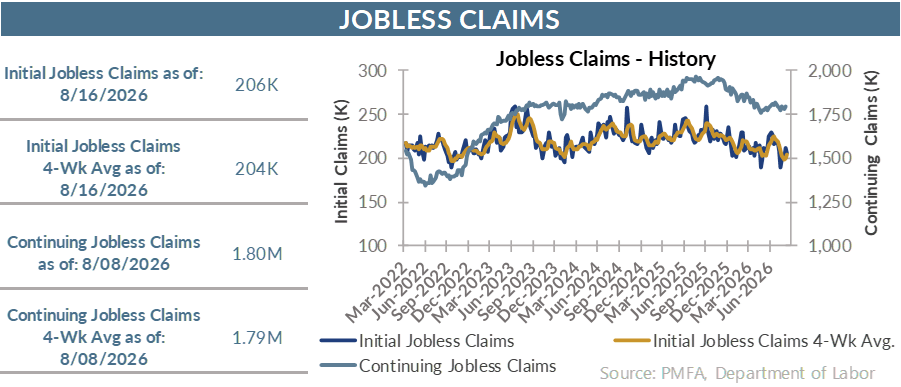
- Initial jobless claims edged lower last week, easing to 206,000 for the week ended August 15 from an upwardly revised 212,000 the week prior.
- Despite the single-week decline, the four-week moving average rose moderately to 204,000.
- Continuing claims rose to 1.799 million for the week ended August 8, but the insured unemployment rate held steady at 1.2%.
- By any measure, claims remain solidly below the corresponding levels of a year ago.
What’s the story?
- There’s very little that can be said about the recent trend in jobless claims data that hasn’t already been acknowledged.
- Job creation has been constrained in recent months after a stronger start to the year; for those looking for work, it’s still not the easiest task. Even so, there are few signs of meaningful deterioration in labor conditions beyond soft hiring. Layoffs remain low, and continuing claims have come down notably over the past year. Unemployment remains low, albeit uneven, with youth unemployment still elevated.
- The result is an uncharacteristic stability in unemployment that — at just 4.1% — has remained rangebound in the ballpark of what economists would view as full employment over the past few years.
- Even so, it doesn’t feel like a rosy job market for a reason — one that hinges on why unemployment has remained so low for so long despite a less than robust hiring environment in recent years.
- The labor force itself continues to shrink, making it easier to hold unemployment in check even in the absence of stronger job creation. A combination of the aging U.S. population and a reversal in recent immigration trends have effectively capped labor force growth.
- The result? Unemployment isn’t rising as it typically would when a growing labor force is met with weak hiring demand. Take labor force growth out of the equation, and the math of unemployment changes.
- Further, employers continue to lean into technology, most notably the rapid expansion in available AI tools, to enhance productivity, further limiting the perceived need to hire at least at the margins.
- Those productivity enhancements provide a buffer against the need to add workers, although the range of adoption across businesses and industries thus far likely translates into a wide range of tangible benefits thus far. The proverbial genie is out of the bottle though, and the impact on productivity will be increasingly apparent in the coming years.
- As for the current state of the labor economy, it still appears to be in a surprisingly sticky equilibrium: one in which employers have limited appetite to hire despite solid growth, but perhaps less motivation to lay off workers against that backdrop.
Past performance does not guarantee future results. All investments include risk and have the potential for loss as well as gain.
Data sources for peer group comparisons, returns, and standard statistical data are provided by the sources referenced and are based on data obtained from recognized statistical services or other sources believed to be reliable. However, some or all of the information has not been verified prior to the analysis, and we do not make any representations as to its accuracy or completeness. Any analysis nonfactual in nature constitutes only current opinions, which are subject to change. Benchmarks or indices are included for information purposes only to reflect the current market environment; no index is a directly tradable investment. There may be instances when consultant opinions regarding any fundamental or quantitative analysis may not agree.
Plante Moran Financial Advisors (PMFA) publishes this update to convey general information about market conditions and not for the purpose of providing investment advice. Investment in any of the companies or sectors mentioned herein may not be appropriate for you. You should consult a representative from PMFA for investment advice regarding your own situation.


