

The bottom line? The “curious balance” in the labor market is still largely intact
- Unemployment claims have remained remarkably — and constructively — rangebound despite ample evidence of a slowing labor economy. Employers may be increasingly reluctant to hire, but they’re also showing no notable shift toward trimming payrolls more aggressively.
- Low layoffs remain a comparative bright spot against an increasingly murky economic outlook. Economic growth had slowed, and hiring had ground to a near standstill before the recent surge in inflation fears, as the conflict in the Middle East has roiled global energy markets and sent prices of crude oil sharply higher.
- For employed workers, the absence of a surge in layoffs should underpin sentiment to a point, but it’s still a very different story for those looking for work, as job openings continue to fall and lower voluntary turnover creates fewer opportunities.
- The bottom line: The labor market has cooled but not cracked. How long can job creation linger in modestly positive territory without slipping into net job losses over a multimonth time frame? That remains to be seen. For now, the choppiness in month-to-month job creation has at least netted to positive, albeit modest, job creation.
By the numbers: Despite tepid hiring, there’s no notable lift in layoffs
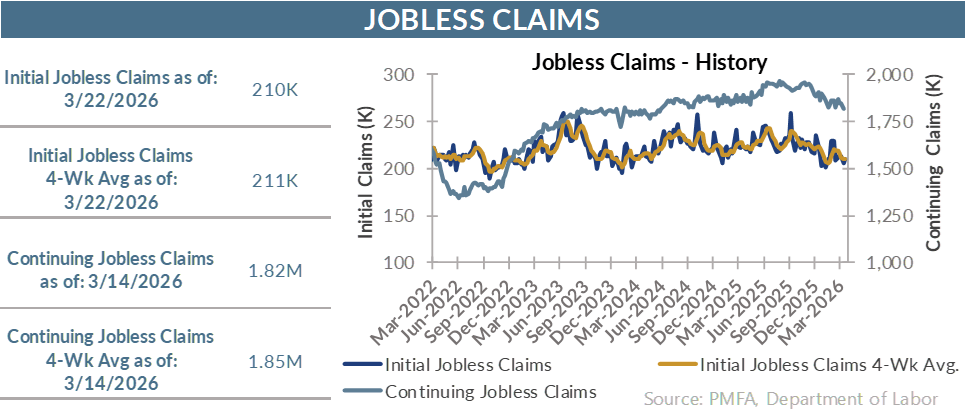
- Initial jobless claims edged higher last week, rising to 210,000 for the week ended March 21 from the prior week’s revised 205,000. Despite the increase, the 4-week moving average eased ever so slightly to 210,500 and remains in a very constructive range.
- Continuing claims eased to 1.819 million, a decline of 32,000 that also delivered a result below forecasts.
What’s the story? Claims data shows a stable labor market
- Last week’s claims data continue to paint a picture of a labor market that’s cooling but not cracking. Hiring has slowed to a near standstill compared to a year ago, yet employers are still holding onto workers, and layoffs remain subdued.
- The current state of the jobs market seemingly reflects a delicate balance for employers who remember all too well the challenge of finding workers to fill their needs just a few years ago but also lack sufficient confidence in the outlook to ramp up hiring. For now at least, that combination appears consistent with an economy that could be slowing, not falling into recession.
- Even so, it also comes against a backdrop of ambiguity that’s been challenged further in the past month by surging oil prices and further deterioration in sentiment. The economy has slowed considerably, and hiring has stalled. While joblessness remains quite low, a decline in labor force participation has kept a lid on the unemployment rate. Absent the departure of individuals from the workforce, unemployment would’ve risen above 5% last month.
- Of critical importance is the consumer sector, which has thus far remained a key underpinning to growth. If sustained, higher gas prices will crimp discretionary spending, while the ripple effect of higher crude prices and transportation costs will become more apparent in the cost of other goods as well.
- Inflation was already frustratingly sticky before the spike in oil prices, a reality that will further squeeze household spending budgets and create an additional headwind to consumers.
- This untimely reacceleration of inflation is arriving as wage growth is already faltering, leaving households feeling the pinch from both sides.
- Despite the challenges present in the labor market, stable and low claims data gives the Fed some breathing room for now. So far, progress on labor‑market moderation is occurring without triggering stress, allowing policymakers some flexibility without creating urgency. Today’s report likely does nothing to encourage a change in policy direction, which has remained in “wait-and-see” mode since last year’s rate cuts.
- Conversely, with near-term inflation risks rising, policymakers will have to grapple with the risk of remaining too accommodative should short-term inflationary forces become too deeply embedded and lift long-term inflation expectations beyond the Fed’s comfort zone.
- Just as the upward rip in crude oil prices will be apparent in inflation data in short order, the potential for a resolution to the conflict could send prices sharply lower. That’s a reality that can’t be dictated by interest rate policy, requiring the Fed to tread carefully in policy execution. If Powell’s tenure to date is any indication, expect a measured response and approach to policy as he winds down his term as Fed chief.
Media mentions:
Our experts were recently quoted on this topic in the following publications:
Past performance does not guarantee future results. All investments include risk and have the potential for loss as well as gain.
Data sources for peer group comparisons, returns, and standard statistical data are provided by the sources referenced and are based on data obtained from recognized statistical services or other sources believed to be reliable. However, some or all of the information has not been verified prior to the analysis, and we do not make any representations as to its accuracy or completeness. Any analysis nonfactual in nature constitutes only current opinions, which are subject to change. Benchmarks or indices are included for information purposes only to reflect the current market environment; no index is a directly tradable investment. There may be instances when consultant opinions regarding any fundamental or quantitative analysis may not agree.
Plante Moran Financial Advisors (PMFA) publishes this update to convey general information about market conditions and not for the purpose of providing investment advice. Investment in any of the companies or sectors mentioned herein may not be appropriate for you. You should consult a representative from PMFA for investment advice regarding your own situation.


