

First, the bottom line: A trifecta of data that affirms economic strength but supports higher rates
- This morning’s data drop on labor conditions, inflation, and growth largely reinforce the existing narrative — one of an economy that’s experiencing strong growth and few cracks in the labor market, but one in which elevated, sticky inflation remains an unwanted byproduct and challenge for consumers.
- The economy continues to demonstrate considerable resilience. Growth was strong in the third quarter, but the underlying details were even better. Real final sales to private domestic purchasers rose 4.9%, underscoring the strength of private sector demand.
- The combination of strong growth, exceptionally low layoffs, and still-elevated inflation presents a challenging backdrop for the Fed. There’s little evidence that the economy is buckling under the weight of current interest rates, while inflation remains sticky and well above the Fed’s 2% target.
- Consumer spending and business investment remain the two primary pillars supporting the economy. Housing remains weak, and trade was a drag, but neither was sufficient to offset the strength elsewhere.
By the numbers: Strong growth, no fire, and sticky inflation
GDP
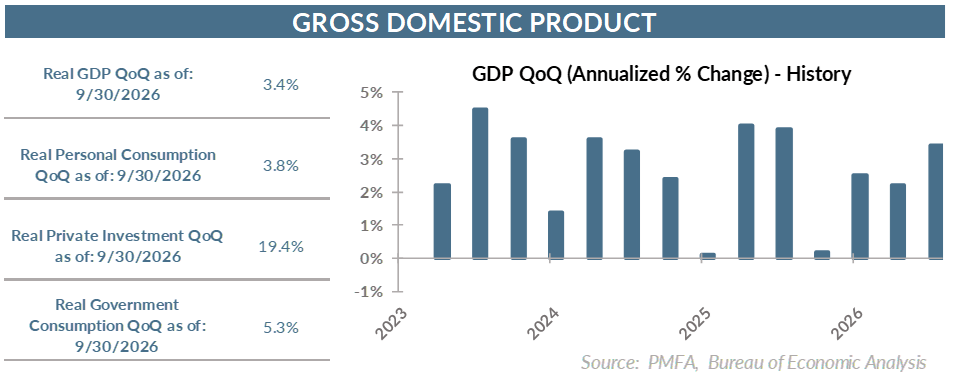
- Real GDP expanded at a 3.4% annualized rate in Q3, accelerating from the second quarter.
- Real final sales to private domestic purchasers rose 4.9%, an especially strong indication of underlying private sector demand.
- On a nominal basis, final sales to private domestic purchasers increased 7.7% — a brisk pace that also points to the underlying strength of consumption and investment.
- Housing remained weak, held in check by persistent affordability concerns resulting from the post-2020 price surge and higher mortgage rates.
- Net exports were a drag, reflecting in part the import-intensive needs of the AI buildout.
- Government spending chipped in with some support, growing by nearly 1% annualized in Q3.
Inflation
- Headline PCE increased 0.5% for the month, while core PCE rose 0.3%. That’s not terribly surprising coming on the heels of hotter-than-expected CPI and PPI readings earlier in the month.
- Headline PCE inflation accelerated to 3.6% year over year, lifted in part by rising fuel prices, although that’s not the full story.
- Core PCE inflation was 3.1% year over year, as already elevated service sector inflation now risks being exacerbated by the flowthrough effects of higher fuel prices.
- By the Fed’s preferred measure, and any other, inflation remains well above the central bank’s 2% target.
Jobless claims
- Initial unemployment claims came in at just 194,000, reconfirming once again the “no fire” underpinning to labor market stability.
- Claims remain historically low, providing further evidence of very limited layoffs.
- Hiring has slowed, but the labor market isn’t booming and it isn’t breaking either, consistent with our recent assessment.
What it means: This morning’s treasure trove of data reinforces the prevailing themes
- The economic trifecta remains intact, reconfirming a backdrop that’s characterized by strong growth, a stable labor market, and persistently sticky inflation that diminishes the benefits of an otherwise solid economy.
- The same two pillars that were lifting the economy in Q2 — consumption and business investment — carried through in Q3, reducing the burden on either to carry the load and keep the economy moving forward.
- To be clear, the underlying growth story remains quite solid. The 4.9% increase in real final sales to private domestic purchasers is particularly noteworthy, illustrating the strength of consumption growth, even adjusted for inflation. It also confirms that strong top-line growth wasn’t merely a function of government spending, nor was it excessively dependent upon inventory volatility or trade data, which can at times obscure the picture.
- Consumers remain an important source of strength, while business investment continues to benefit from significant spending on AI, data centers, technology, and related infrastructure. Household spending strength has regained steam in recent quarters, a welcome — although interesting — development given consistently poor readings on sentiment. The hard data doesn’t lie; as a group, consumers continue to find ways to spend despite the corrosive effect of inflation on purchasing power.
- That AI investment creates an unusual near-term/long-term tradeoff. The massive investment underway today is adding to aggregate demand and contributing to the inflationary impulse as a driver of demand. Over time, however, the hoped-for productivity gains could expand productive capacity, allowing AI to shift from an inflationary to a much-needed disinflationary catalyst. How soon that shift may occur remains an open question — one that’s undoubtedly one variable in the Fed’s rate-setting calculus.
- Inflation remains the key concern. Higher energy prices have contributed to the recent acceleration, but the greater risk is that those pressures are beginning to filter more broadly through the economy. Higher fuel and diesel prices raise transportation and distribution costs and can ultimately contribute to higher prices in core goods, not just the headline data. That’s a key distinction that enhances the risk that inflation could become stickier even if prices at the pump ease.
- Labor market strength is making the Fed’s job easier by allowing policymakers to focus on inflation. Initial claims of 194,000 last week reconfirm that employers aren’t trimming payrolls. Layoffs have held firm in a narrow, constructive range, reinforcing the broader picture of an economy that continues to withstand higher interest rates remarkably well.
- Taken together, today’s reports reinforce the challenge facing the Fed. Growth is strong, private domestic demand is stronger still, layoffs remain low, and inflation remains elevated. Yesterday’s decision to hold rates steady gives policymakers additional time to assess whether inflation pressures will subside, but today’s data reinforces the growing question for Fed-watchers: What more do you need to see to tighten further?
- The economy simply isn’t sending a clear signal that it needs additional monetary policy support. If anything, it’s the opposite. Sticky inflation accompanied by accelerating growth and firm labor market conditions would seem to point clearly in the direction of further tightening.
- The case for the Fed to assume an increasingly restrictive stance is a strong one, and today’s data reinforces that case.
Past performance does not guarantee future results. All investments include risk and have the potential for loss as well as gain.
Data sources for peer group comparisons, returns, and standard statistical data are provided by the sources referenced and are based on data obtained from recognized statistical services or other sources believed to be reliable. However, some or all of the information has not been verified prior to the analysis, and we do not make any representations as to its accuracy or completeness. Any analysis nonfactual in nature constitutes only current opinions, which are subject to change. Benchmarks or indices are included for information purposes only to reflect the current market environment; no index is a directly tradable investment. There may be instances when consultant opinions regarding any fundamental or quantitative analysis may not agree.
Plante Moran Financial Advisors (PMFA) publishes this update to convey general information about market conditions and not for the purpose of providing investment advice. Investment in any of the companies or sectors mentioned herein may not be appropriate for you. You should consult a representative from PMFA for investment advice regarding your own situation.


